JFK's Forgotten Crisis: Tibet, the CIA, and Sino-Indian War by Bruce Riedel
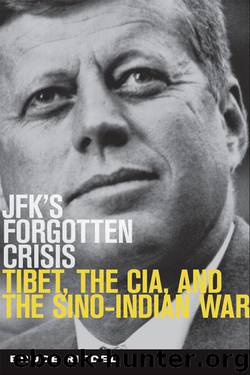
Author:Bruce Riedel [Riedel, Bruce]
Language: eng
Format: epub
Publisher: Brookings Institution Press
Published: 2015-11-05T18:30:00+00:00
Galbraith's and Kennedy's Response
On October 20 Ambassador Galbraith was in London to give a speech. He was staying at the Ritz Hotel when “a lad” from the U.S. Embassy in London arrived at his room in the middle of the night with a “TOP SECRET EYES ONLY” message from President Kennedy instructing him to immediately return to New Delhi. In his diary he wrote, “My lectures sponsors were unhappy but naturally did not argue with a war.”12 He was back in New Delhi on October 22.
Galbraith did not know that a week before, on October 15, a CIA U-2 flight over Cuba had photographed Soviet soldiers building launch facilities for medium-range ballistic missiles. The CIA had orally briefed National Security Adviser McGeorge Bundy late that day about the findings. By the next morning a CIA report on the imagery had been written and Kennedy briefed. The president then instructed Bundy to convene an urgent meeting of his national security advisers, a group called the EXCOMM; it would continue to meet several times a day throughout the thirteen days of the Cuban missile crisis, in the Cabinet Room immediately adjacent to the Oval Office.
The White House kept the news of the Soviet missile bases in Cuba secret until the president addressed the nation on October 22. Kennedy's earlier EYES ONLY message for Galbraith in London related to the Cuban crisis, not the Sino-Indian War; he wanted his friend Ken to return to India to explain to Nehru U.S. policy on the placement of missiles in Cuba. It was a useful coincidence that this order also put Galbraith back on the scene as the first major Chinese attack was getting underway.13
At the time Americans believed that the Cuban missile crisis was the most dangerous moment in the cold war, the closest that the United States and the USSR came to a direct military clash that would precipitate nuclear war and global Armageddon. Decades later we know from Soviet records that it was even more dangerous than was thought in 1962. At the time the CIA estimated there were from 6,000 to 8,000 Soviet troops on the island; in fact, there were 50,000. Unbeknownst to the CIA and JFK, the Soviets had sent not only medium- and intermediate-range ballistic missiles to Cuba but also tactical missiles called FROGs loaded with nuclear warheads. Soviet forces on Cuba were ready to fire nuclear weapons at the U.S. Naval Base at Guantanamo Bay with its garrison of 5,000 Marines if the Americans decided to bomb the longer-range missiles and warheads that threatened its cities.
The president had ordered the Pentagon to draw up plans to invade Cuba. The main plan, Operation Scabbard, involved 120,000 troops from eight divisions going ashore in a D-day–like assault. In addition, two Army airborne divisions would parachute into Cuba, and the First Marine Division would conduct a separate landing. Three aircraft carrier battle groups, including the first ever nuclear-powered carrier, USS Enterprise, would provide air support. Undoubtedly in response, the Soviets would have used tactical nuclear weapons to defend the beaches.
Download
This site does not store any files on its server. We only index and link to content provided by other sites. Please contact the content providers to delete copyright contents if any and email us, we'll remove relevant links or contents immediately.
| Anthropology | Archaeology |
| Philosophy | Politics & Government |
| Social Sciences | Sociology |
| Women's Studies |
The Secret History by Donna Tartt(19484)
The Social Justice Warrior Handbook by Lisa De Pasquale(12301)
Thirteen Reasons Why by Jay Asher(9136)
This Is How You Lose Her by Junot Diaz(7078)
Weapons of Math Destruction by Cathy O'Neil(6489)
Zero to One by Peter Thiel(5957)
Beartown by Fredrik Backman(5954)
The Myth of the Strong Leader by Archie Brown(5633)
The Fire Next Time by James Baldwin(5599)
How Democracies Die by Steven Levitsky & Daniel Ziblatt(5339)
Promise Me, Dad by Joe Biden(5240)
Stone's Rules by Roger Stone(5198)
A Higher Loyalty: Truth, Lies, and Leadership by James Comey(5092)
100 Deadly Skills by Clint Emerson(5036)
Rise and Kill First by Ronen Bergman(4914)
Secrecy World by Jake Bernstein(4900)
The David Icke Guide to the Global Conspiracy (and how to end it) by David Icke(4858)
The Doomsday Machine by Daniel Ellsberg(4634)
The Farm by Tom Rob Smith(4614)
